# The Impact of AI for Sales and Marketing in 2026
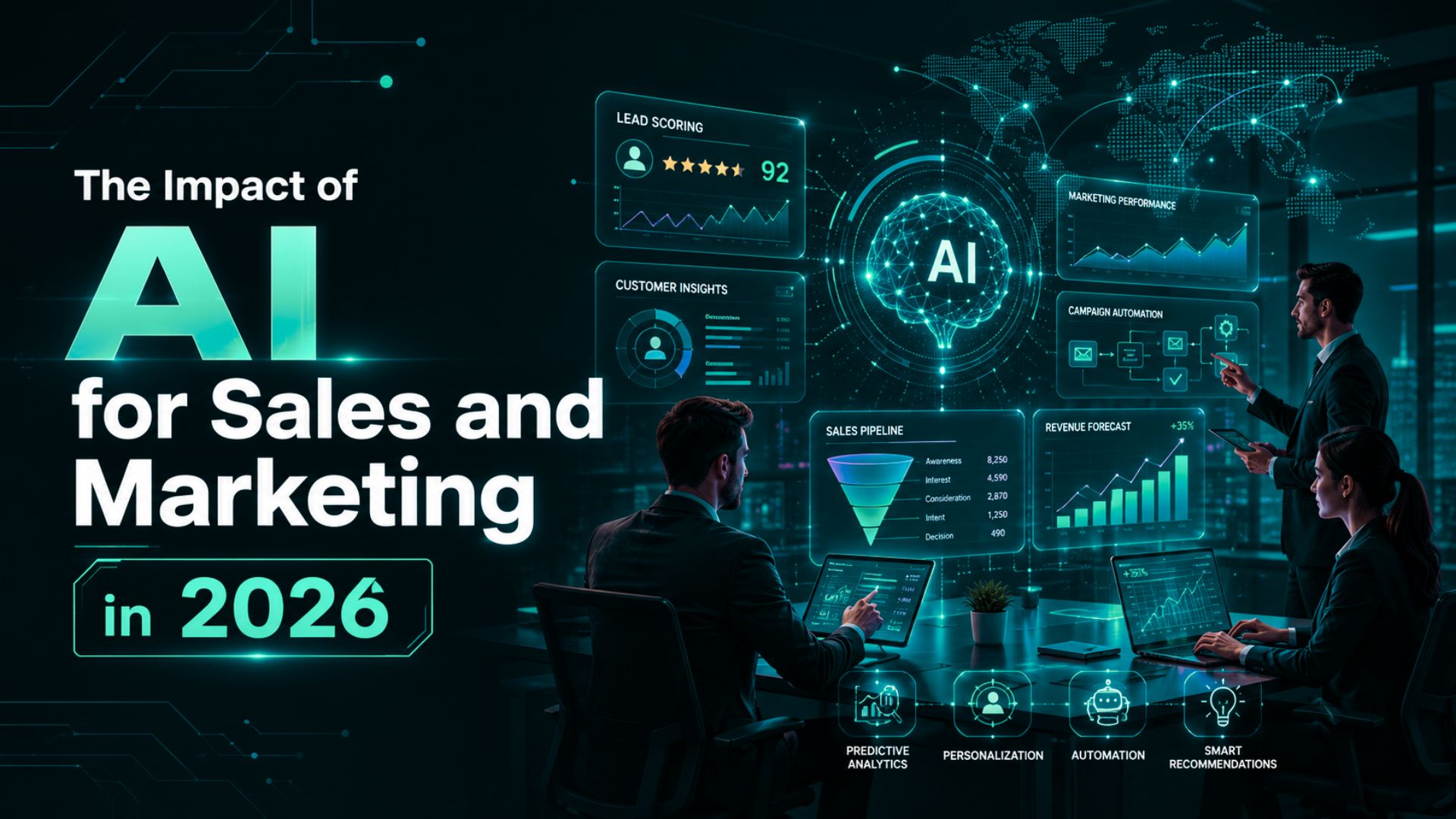
Are businesses winning more customers with AI in 2026? Here's the short answer.
Yes. AI for sales and marketing has become one of the biggest competitive advantages for modern businesses in 2026. Companies now use artificial intelligence to identify qualified prospects, personalize customer interactions, automate repetitive tasks, predict buying behavior, and improve campaign performance. Rather than replacing sales and marketing teams, AI empowers them to make faster decisions, increase efficiency, and create better customer experiences.
Organizations of every size are embracing AI because it reduces manual work while helping teams focus on building stronger relationships and closing more opportunities. From predictive analytics to intelligent customer conversations, AI is reshaping every stage of the customer journey.
**Why AI Is Transforming Sales and Marketing in 2026**
Artificial intelligence has evolved from being a helpful assistant into a strategic business partner. Modern AI systems analyze massive amounts of customer data in seconds, uncover hidden patterns, and provide recommendations that help teams act with greater confidence.
Several factors are driving this transformation:
* Improved machine learning models
* Better customer data integration
* Real-time personalization
* Faster decision-making
* Increased marketing automation
* Predictive customer intelligence
Instead of relying on guesswork, businesses now make data-driven decisions that improve customer engagement while reducing operational costs.
**Smarter Lead Generation and Qualification**
Finding the right prospects has always been one of the biggest challenges for sales professionals. AI simplifies this process by evaluating customer behavior, engagement history, demographics, and buying signals simultaneously.
Modern AI platforms can:
* Identify high-intent prospects
* Prioritize leads automatically
* Score leads using predictive analytics
* Recommend the best follow-up timing
* Detect potential upselling opportunities
Sales representatives spend less time researching and more time engaging with qualified prospects, resulting in higher productivity across the pipeline.
**Personalized Customer Experiences at Scale**

Today's customers expect every interaction to feel relevant. AI makes large-scale personalization possible without increasing workload.
Businesses can automatically personalize:
* Email campaigns
* Product recommendations
* Landing pages
* Website experiences
* Customer support interactions
* Marketing offers
Instead of sending identical messages to thousands of people, companies deliver content that matches each customer's interests and purchase stage.
Around this stage of the customer journey, AI also helps optimize ***[outbound sales calls](https://callified.ai/blog/outbound-sales-calls-conversions/)*** by analyzing conversation history, customer preferences, and engagement signals before representatives make contact, allowing discussions to begin with stronger context and greater relevance.
**AI Makes Marketing Campaigns More Intelligent**
Marketing teams no longer need to wait weeks before understanding campaign performance.
AI continuously monitors:
* Audience engagement
* Conversion trends
* Advertising performance
* Customer segmentation
* Content effectiveness
* Budget allocation
The technology identifies underperforming campaigns early and recommends improvements automatically. Marketers can test multiple variations simultaneously while AI determines which combinations generate the strongest results.
This continuous optimization helps businesses maximize every marketing investment.
**Better Sales Forecasting Through Predictive Analytics**
Forecast accuracy has traditionally depended on experience and historical reports. AI enhances forecasting by combining real-time customer behavior with historical business data.
Benefits include:
* More accurate sales projections
* Improved inventory planning
* Better staffing decisions
* Earlier risk identification
* Smarter budget planning
Leadership teams gain greater confidence when planning future business strategies because AI provides ongoing insights instead of static reports.
**AI-Powered Customer Conversations**
Conversational AI has become significantly more sophisticated in 2026.
Intelligent voice assistants and chat systems now:
* Answer customer questions naturally
* Schedule appointments
* Qualify leads
* Handle repetitive inquiries
* Transfer complex conversations to human agents
Solutions such as Callified AI demonstrate how AI-powered voice conversations can support sales teams by automating routine customer interactions while allowing representatives to focus on higher-value opportunities.
**Data-Driven Decisions Create Sustainable Business Growth**

AI enables organizations to measure nearly every customer interaction across multiple channels.
Businesses gain insights into:
* Customer lifetime value
* Buying behavior
* Campaign attribution
* Sales performance
* Market trends
* Customer satisfaction
These insights help leaders make smarter strategic decisions rather than relying solely on intuition.
Approximately another stage in the business growth cycle, organizations that consistently use AI-generated insights often achieve stronger ***[revenue growth](https://www.bib.az/blogs/114909/How-AI-Powered-Solutions-Accelerate-Revenue-Growth)*** because decisions are supported by measurable customer behavior rather than assumptions.
**Challenges Businesses Should Consider**
Despite its advantages, AI implementation requires thoughtful planning.
Common challenges include:
* Maintaining data privacy
* Ensuring data quality
* Integrating existing software
* Training employees
* Preventing algorithm bias
* Monitoring AI-generated recommendations
Successful organizations treat AI as a decision-support system instead of relying on automation alone. Human oversight remains essential for building trust, maintaining brand authenticity, and handling complex customer relationships.
**Best Practices for Using AI Successfully**
Businesses can maximize AI adoption by following several practical principles:
* Start with clearly defined business objectives.
* Keep customer data accurate and organized.
* Combine AI insights with human expertise.
* Continuously measure performance improvements.
* Train employees to work alongside AI technologies.
* Review AI recommendations regularly for accuracy.
Organizations that approach AI strategically typically experience faster adoption and stronger long-term results.
Also watch this video - ***[Meet Callified AI | Your AI Sales Team That Never Sleeps](https://youtu.be/cQ8QsephGKI?si=zPMCc1XGaWJJboY2)***
**Conclusion**
Artificial intelligence is no longer an emerging trend; it has become a core driver of modern business success. Companies that embrace ***[AI tools for sales and marketing](https://callified.ai/blog/ai-for-sales-and-marketing/)*** can improve efficiency, personalize customer experiences, strengthen forecasting, and make smarter strategic decisions. As AI technology continues to evolve throughout 2026, businesses that combine automation with human expertise will be better positioned to build lasting customer relationships and remain competitive in an increasingly data-driven marketplace.
**Frequently Asked Questions**
Q1. How does AI improve sales performance?
AI helps sales teams prioritize qualified leads, automate repetitive tasks, analyze customer behavior, and recommend the best actions to improve conversion rates.
Q2. Can small businesses benefit from AI?
Yes. Many affordable AI solutions help small businesses automate marketing, improve customer communication, and make better business decisions without requiring large teams.
Q3. Does AI replace sales and marketing professionals?
No. AI enhances human capabilities by automating repetitive work and providing actionable insights, allowing professionals to focus on strategy, creativity, and relationship building.
Q4. What should businesses consider before implementing AI?
Organizations should evaluate data quality, employee training, system integration, privacy compliance, and long-term business objectives before adopting AI solutions.