**Could Better Workplace Visibility Come With Bigger Privacy Risks? A Guide to Screen Recording**
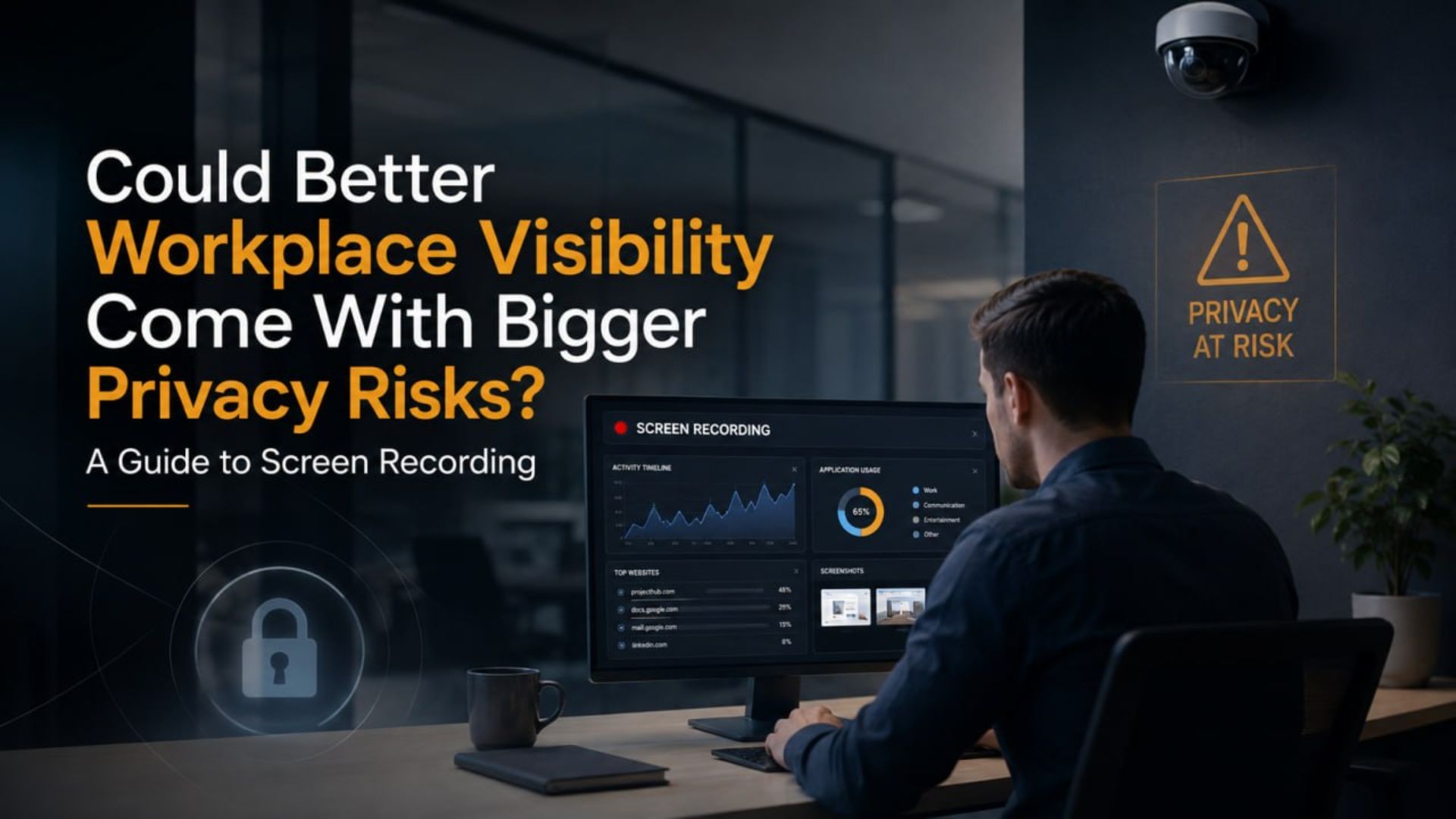
How much visibility does a business really need before workplace oversight becomes counterproductive? It can help organizations understand digital workflows, investigate unusual activity, review processes, and identify operational bottlenecks. But greater visibility does not automatically produce greater productivity. In practice, the value comes from knowing what information matters, why it is being collected, and how it will influence decisions. Responsible organizations therefore treat ***[Screen Recording](https://empmonitor.com/blog/employee-screenshot-and-screen-recording-2026-call-centers/)*** as one component of workforce management rather than a replacement for communication or trust. A thoughtful approach combines transparency, limited data collection, clear policies, appropriate access controls, and measurable objectives so technology supports better work instead of creating unnecessary pressure.
**What Does It Actually Do?**
The technology captures visual activity from a computer screen, either continuously or at configured intervals. Depending on the platform, businesses may also receive timestamps, application activity, website information, productivity indicators, or other contextual data.
That information can be useful in specific situations. A support department, for example, may review how representatives navigate a customer-service platform when investigating process inconsistencies. A technical team could use captured activity to understand how a recurring software issue occurred. Managers may also use visual evidence when reviewing workflow problems that cannot be explained through task reports alone.
However, more information does not necessarily mean better information.
A large collection of recordings can become difficult to review and easy to misinterpret. An employee may appear inactive on a particular application while working through a complex problem elsewhere. Someone may spend several minutes reading documentation before completing a task that takes only seconds to execute.
This is why context matters more than raw observation.
**How Can Businesses Use It Responsibly?**
A responsible implementation begins with a clearly defined business purpose.
Organizations should identify the specific problem they want to solve before selecting monitoring technology. Security investigations, compliance, quality assurance, process improvement, and workflow analysis can all provide legitimate reasons. A vague objective such as “watch employees more closely” creates unnecessary risks and makes the resulting data difficult to interpret.
Transparency should follow. Employees should understand what information is collected, when monitoring occurs, who can access it, and how long relevant data may be retained. Clear communication can reduce uncertainty and demonstrate that ***[employee monitoring](https://empmonitor.com/blog/why-employee-monitoring-deployments-backfire/)*** is governed by a consistent policy rather than individual managerial preferences.
Data minimization is another important principle. If a business only needs limited information to understand workflow efficiency, collecting and retaining extensive visual data may be excessive.
Access should also be restricted. Sensitive recordings should not become broadly available simply because a platform makes them easy to retrieve. Organizations should establish appropriate permissions, retention rules, and internal procedures for reviewing collected information.
**What Does It Cost?**

The cost depends on the provider, number of employees, storage requirements, reporting features, integrations, and subscription structure. Some services charge per user, while others include monitoring capabilities within broader workforce-management packages.
The software price, however, is only one part of the calculation.
Businesses should also consider administrative time, storage, configuration, employee training, IT support, policy development, and compliance requirements. A platform that appears inexpensive can become costly if managers spend significant time reviewing irrelevant information.
The strongest purchasing decision is therefore based on business value rather than the lowest monthly subscription.
**How Does It Compare With Less Intrusive Alternatives?**
Not every workplace problem requires visual monitoring.
Time and attendance systems can help organizations understand schedules and working hours. Application and website analytics can provide broader behavioural patterns without necessarily capturing every visual detail. Task-management platforms can show assignments, deadlines, completion rates, and project progress.
Each approach answers a different question.
If management wants to understand whether projects are progressing, task data may be sufficient. If the concern involves attendance, scheduling information may provide a clearer answer. If a security incident requires detailed investigation, visual evidence could have greater value.
The best solution is therefore the least intrusive method capable of answering the business question accurately.
You can also watch: ***[EmpMonitor|Leading Employee Engagement and Workforce Productivity Tool](https://youtu.be/vyhUwnsjlro?si=tsyG1MD-RvMXh9Bg)***
**Conclusion**
***[Screen Recording](https://empmonitor.com/blog/employee-screenshot-and-screen-recording-2026-call-centers/)*** can provide valuable visibility when used for a specific and defensible purpose, but its effectiveness depends on how thoughtfully an organization implements it. Businesses should compare it with less intrusive alternatives, calculate the full cost, establish transparent policies, and avoid treating screen activity as a direct measure of employee performance. The strongest monitoring strategy is not necessarily the most detailed one. It is the one that produces useful insight while respecting people and supporting measurable business outcomes. Evaluate your workplace needs, define clear policies, and choose monitoring technology with purpose rather than pressure.
**FAQs**
Is Screen Recording legal for employees?
It depends on local laws, company policies, and privacy requirements. Clear employee notice is essential.
How much does employee monitoring software cost?
Pricing varies by users and features. Advanced tools may include Screen Recording, analytics, and reporting.
What is the best alternative to screen monitoring?
Time tracking, task management, and application analytics can offer visibility with less intrusive monitoring.